

Ever wondered what goes into building a custom guitar? In this article, we’re going to pull back the curtain and detail the process from the initial design stage, through to the final setup.
Design & Planning
The first step in having a custom guitar built is the initial design. Depending on where you have the guitar made, this will be in the form of a design consultation, or in our case, you can design your custom guitar using our custom guitar design tool, which shows a visual representation of the guitar on your computer screen.

In either case, the following components/features must be decided upon:
Construction Method (Fundamentals):
- Orientation: Left or right-handed
- Neck Joint: Either set neck (glued), or bolt-on (more on this further along).
- Scale Length: The length of the guitar string able to freely vibrate e.g. the distance between the nut and bridge. This affects the string tension and spacing of the frets.
Aesthetics:
- Body Shape & Size: Does the client want a classic shape or something unique? in which case a CAD (Computer Aided Design) drawing will usually be supplied, or designed in consultation with the client.
- Veneer: A maple veneer (usually spalted, flame, or quilted maple) may be requested. Veneers are chosen purely for aesthetic purposes to display an interesting wood grain pattern beneath a semi-transparent finish. Ranging from 0.020 inch (about 0.5mm) to 0.125 inch (about 3.175mm). A veneer should not be confused with a maple cap, which is a solid piece of maple wood that is glued to the top of a guitar body. The thickness can vary, but maple caps are generally between 1/4 inch (about 6.35mm) to 3/4 inch (about 19mm). Unlike a veneer, a cap can influence the tonal characteristics of a guitar because of its thickness and mass, while also offering visual appeal.
- Color & Finish: Your choice of color or burst e.g. sunburst, cherry burst, or natural wood grain, and clear protective coat e.g. glossy, or satin clear coat.
- Inlays and Side Dots: Simple dots, trapezoids, blocks, or more ornate designs.
- Binding: Some guitars feature binding on the body, neck, and/or headstock. This is usually for both aesthetic reasons and to protect the edges of the guitar.
- Hardware Color: Chrome, gold, or black are the most common options.
Sound:
The tonality of a guitar is the synergistic result of many different factors, however, the three listed below are the most influential.
- Tonewood Preferences: Different woods can impart different tonal qualities, due to their density and mass. You can read more here about how tonewoods influence tone.
- Pickup Configuration and Pickup Types: Single-coils, humbuckers, or P-90s? The type, brand, and configuration can drastically change the guitar’s sound. You can read more here about pickups and their influence on tone and response.
- Electronics: Will the guitar have a basic electronics setup with a volume and tone knob or multiple knobs and switches.
Playability:
The playability of the guitar is largely dictated by the neck, often referred to as the user interface of the guitar.
- Neck Profile: This describes the shape of the neck. e.g. thin and flat? thick and rounded? This affects how the guitar feels in the hand.
- Frets: This includes the number of frets, and materials used and can influence playability and comfort.
- Fretboard Radius: Specifically the roundness of the fretboard. A rounder radius can be advantageous for playing chords, while a flatter radius can be beneficial for faster playing.
- Nut: The nut is located at the top of the fretboard, and along with the saddles (located on the bridge) serves as the point of contact for the strings and can influence resonance, tuning stability, string spacing, and to a lesser extent sustain.
Materials Selection:
The materials chosen for the guitar influence aspects such as the weight of the guitar and balance, along with tonality and feel.
Tonewoods:
- Body Woods: Common choices include alder, ash, mahogany, paulownia, and basswood. Each has its own tonal characteristics and weight.
- Neck Woods: Maple and mahogany are popular choices.
- Fretboard Woods: Rosewood, maple, and ebony are common, and offer variations in feel and tone.
Hardware:
- Tuners: Locking tuners, or standard? Brands like Grover are popular.
- Bridge & tailpiece: Fixed bridge, tremolo system, or a through-body design?
Inlay, Pickguard, Cavity Covers and Binding Materials:
- Traditional materials include plastic (pickguards and cavity covers), mother of pearl, and abalone (inlays).
Building the Body and Neck
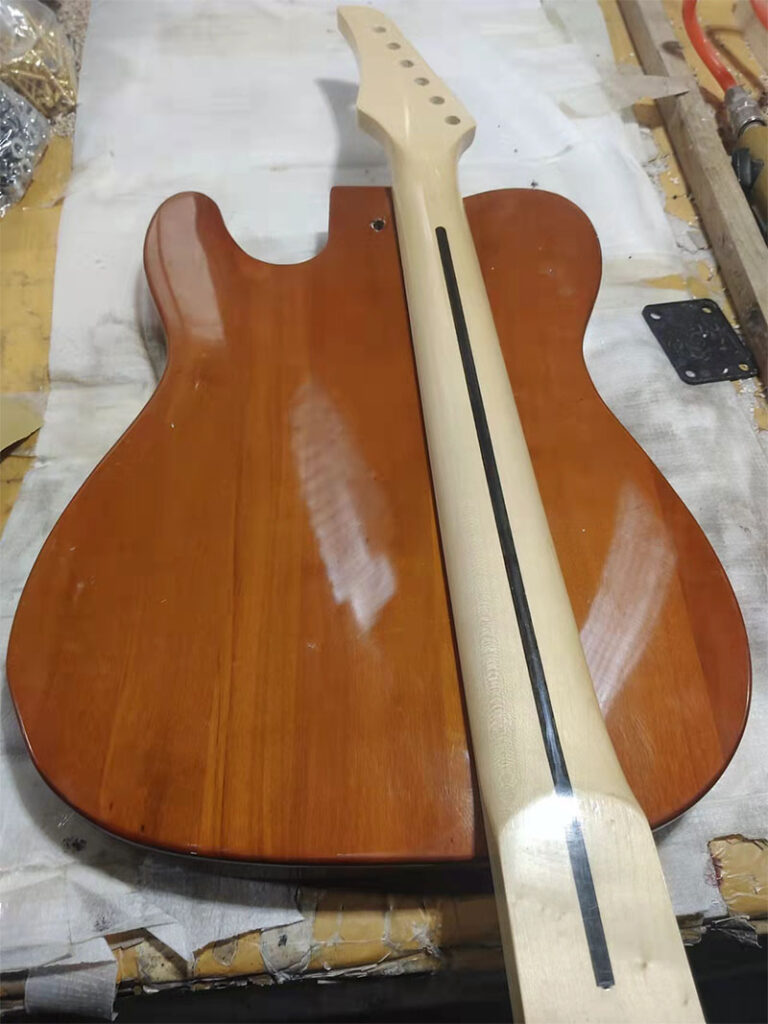
Cutting & Shaping:
This is the initial step to transform a raw block or slab of wood into the rough shape of a guitar body or neck.
- Manual Cutting: Historically, and still common among individual luthiers or for bespoke instruments, the process starts with a bandsaw or jigsaw to cut the raw wood into the basic outline of the guitar body. Hand tools like rasps, files, and spokeshaves might then be used to refine the shape.
- Machined Cutting: In modern factories like CNC (Computer Numerical Control) routers have become invaluable. These machines use computer-generated designs (from CAD software) to precisely cut and shape the wood. They offer high precision and consistency. This is one of the primary reasons entry-level and mid-range electric guitars have become so much better in recent years.
Routing:
Routing refers to the process of hollowing out or creating cavities in the wood.
- Pickup Cavities: These are hollowed-out areas where the guitar’s pickups will be placed. The size and shape of these cavities depend on the type of pickups (single-coil, humbucker, P-90, etc.).
- Neck Joint: Depending on the type of guitar, there might be a cavity for a bolt-on neck or a pocket for a set neck.
- Electronics Cavities: These are spaces for the guitar’s wiring, pots (volume and tone controls), and switches. On solid-body guitars, this cavity is typically at the back and might have a plastic or wooden cover. Semi-hollow or hollow-body guitars often have the electronics installed through the pickup cavities or the sound holes.
Carving:
While not applicable to all guitars, carved tops (often seen on guitars like the Gibson Les Paul) add a contour and aesthetic appeal.
- Manual Carving: Using gouges, planes, and scrapers, luthiers carve the top of the guitar to create its rounded shape. This requires a significant amount of skill to ensure symmetry and a smooth finish.
- Machined Carving: Again, CNC machines can be programmed to handle this task with precision, especially in large-scale manufacturing.
- Other Carvings: Some guitars have additional carved designs, contours for player comfort (like arm or belly cuts), or even deep reliefs for aesthetic purposes.
Fretboard:
The fretboard is a separate piece of wood that’s attached to the neck. It’s a critical component for playability and pitch accuracy.
- Choosing the Wood: Common woods include rosewood, maple, and ebony. The choice can affect both aesthetics and feel.
- Cutting: The chosen wood is cut into a thin slab, roughly the length and width of the guitar’s neck.
- Radiusing: The flat slab is then shaped to have a curve or radius. This curvature can vary, affecting playability. Some guitars feature compound radii, which means the curve’s tightness changes along the length of the fretboard.
- Slotting: Precise slots are cut into the fretboard for the metal frets. Their spacing is calculated based on the scale length of the guitar to ensure accurate pitch along the neck.
- Inlays: At this stage, decorative inlays (dots, shapes, or custom designs) can be added to the fretboard. These serve as markers to help players navigate the neck.
Initial Assembly
While this may differ between luthiers the initial assembly is performed prior to finishing and involves truss rod installation, connecting the neck (if a set neck guitar), and fixing the fretboard to the neck.
Neck
- Truss Rod Installation:
- The truss rod is a metal rod inserted into the neck of the guitar to maintain the stability of a guitar’s neck and allow for adjustments to the neck’s curvature (or relief).
- Before the fretboard is attached, a channel is routed out along the back or middle of the neck to accommodate the truss rod.
- Once placed into this channel, the truss rod is covered either by the back of the neck (in a skunk stripe design) or, more commonly, by the fretboard.
- Access to adjust the truss rod is typically at the headstock or, in some cases, at the heel of the neck.
- Fretboard Gluing:
- The fretboard is then glued to the neck. It’s crucial to ensure it’s aligned correctly, as mistakes here can affect playability and intonation.
- Clamps are used to hold the fretboard in place while the glue dries, ensuring a tight bond.
Body & Neck Joining:
- Bolt-On Neck:
- Common on Fender guitars, this method involves bolting the neck onto the body using screws and a metal plate. It allows for easier neck replacements or adjustments. (In many cases this will be done after finishing).
- Set-Neck:
- Seen in guitars like Gibsons, the neck is permanently glued to the body. This method provides a smoother transition between the neck and body and is believed by many to offer better sustain and resonance because of the continuous wood-to-wood contact.
- Neck-Through Design:
- Here, the neck extends through the entire length of the guitar body, with “wings” or body sections glued to the sides of this central piece. This design can offer improved sustain and a smoother transition between the neck and body.
Fretting:
- Fret Wire Selection:
- Frets come in various sizes and materials. Their size (height, width) can affect playability, and the material (nickel-silver, stainless steel) can influence tone and durability.
- Installation:
- After the fretboard slots are cut, fret wires are bent slightly to match the radius of the fretboard.
- They are then either pressed into the slots using a fret press or hammered in using a soft mallet.
- Once installed, the fret ends are trimmed and filed to ensure they’re smooth to the touch. The frets are also leveled, crowned, and polished to ensure optimal playability and intonation.
Finishing
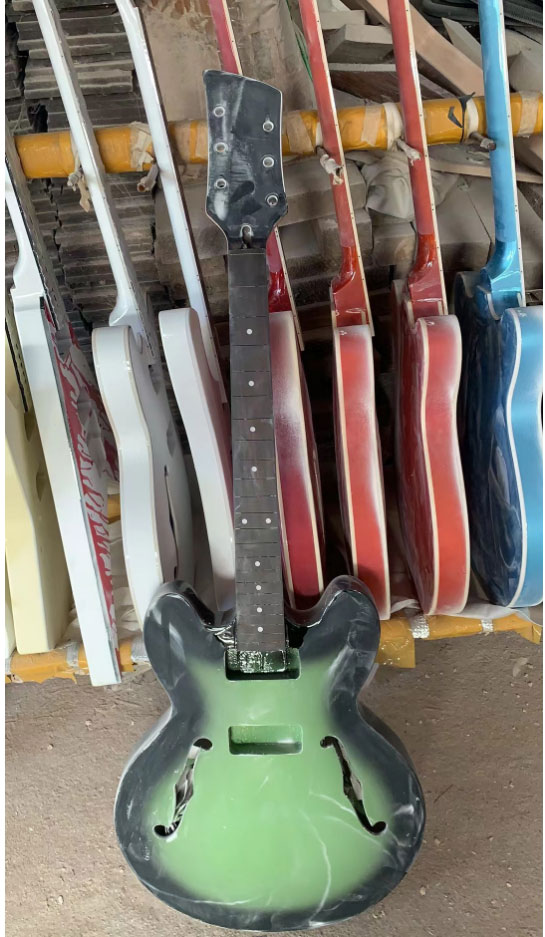
The finishing phase is both an art and a science. While the technical aspects ensure the guitar is protected and durable, the aesthetic choices contribute significantly to the instrument’s visual appeal.
Sanding:
- Purpose: Sanding is crucial for achieving a smooth surface. Any imperfections left on the wood can affect the final appearance and feel of the guitar.
- Graded Sanding: The process typically starts with coarser sandpaper to remove any major inconsistencies and then moves to progressively finer grits to achieve a silky smooth finish. This step-by-step progression ensures that any scratches from a coarser grade are removed by the finer grades.
- Hand vs. Machine Sanding: While machines can be used for the initial, rougher sanding stages, the final stages, especially on the more detailed parts of the guitar like the neck or carved top, are often done by hand to ensure precision.
Sealing:
- Grain Filling: Woods with open grain structures like mahogany or ash, have tiny pores that need to be filled to achieve a smooth finish. Grain fillers, often made from a paste, are used to fill these microscopic gaps.
- Sanding Sealer: This is a preliminary coat, usually of a clear substance, that preps the wood for the final finish. It can help highlight any remaining imperfections and ensures better adhesion of subsequent finish layers.
Finishing:
- Types of Finishes:
- Lacquer: A popular finish for many vintage and high-end guitars. It’s relatively thin, allowing the wood to resonate more freely. Over time, it can develop a natural, aged look that many find appealing.
- Polyurethane/Polyester: These are more modern finishes that are thicker and more resilient than lacquer. They offer great protection.
- Oil Finishes: Often used for necks or certain boutique guitars, oil finishes are thin and provide a more natural feel but offer less protection against moisture and dings.
- Application: Multiple coats of the chosen finish are applied. Each layer needs to dry or cure properly before the next is added. The thickness and number of coats can influence the guitar’s final look and feel.
- Intermediate Sanding: Between coats, especially with lacquer or poly finishes, light sanding using very fine-grit sandpaper is done to smooth out any imperfections, ensuring each subsequent layer is as flawless as possible.
Coloring & Aesthetics:
- Staining & Tinting: Before applying the main finish, the wood can be stained or tinted to achieve the desired color. This can range from natural wood shades to vibrant colors. In some cases, a darker dye is applied to highlight the grain pattern of the wood before being sanded back, leaving just the accentuated grain lines showing.
- Sunburst & Fades: A sunburst finish is a gradient that’s typically darker on the edges and lighter in the center. This, and other gradient finishes, are applied using a spraying technique where colors are blended.
- Protective Coats: Once all color and aesthetic treatments are applied, clear protective coats are sprayed to seal the color coats and provide a protective barrier against wear and tear.
Hardware Installation:
Once the finishing stage is completed hardware is installed. This includes:
- Pickups and Electronics: Pickups are installed, however, the final wiring is usually done as a last step during the final setup phase (this may vary between manufacturers).
- Tuners: Installed on the headstock, tuners allow players to adjust the pitch of each string. Their quality and design can significantly affect tuning stability.
- Bridge & Tailpiece: The bridge supports the strings and allows for intonation and action adjustments. The tailpiece anchors the strings to the body.
- Other Hardware: This can include control knobs (for volume and tone), switches (to select different pickups or configurations), strap buttons, and possibly more specialized hardware like tremolo systems or piezo pickups.
The assembly phase is a convergence of all prior work stages. Precision, attention to detail, and knowledge of the instrument’s design are paramount to ensure that the finished guitar not only looks good but also plays and sounds its best.
Setup
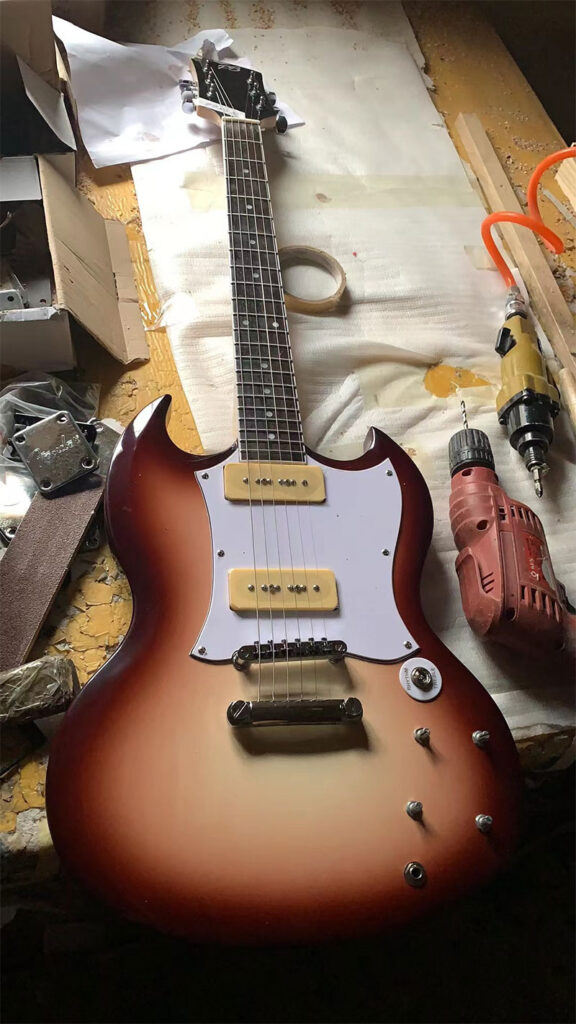
The final setup is a critical step that can greatly enhance the playability of the guitar. This is the stage where the nut is cut, intonation is adjusted, frets are dressed (more on this shortly), the string action (string height) is adjusted, and the neck relief via the truss rod is set.
Fret Leveling & Dressing:
- Fret Leveling: Due to manufacturing variances, some frets on a guitar may sit higher than others. This inconsistency can lead to string buzzing or dead spots on the fretboard. To level the frets:
- The neck is first adjusted to be as straight as possible using the truss rod.
- A long, flat sanding block or specialized leveling tool is then run across the frets to ensure they are all even with each other.
- Fret Dressing: After leveling, the frets might become flat on top. Dressing restores them to their rounded shape, which limits the contact point for the string, minimizing the chances of string buzz developing.
- The frets are “crowned” using a fret crowning file. This means making them round again but without reducing their height.
- After crowning, the frets are polished to a smooth shine using progressively finer grades of sandpaper, followed by steel wool and fret rubbers. This ensures a smooth feel when bending strings and playing.
Nut Cutting:
- Purpose: The nut, typically made of bone, plastic, or graphite is crucial for proper intonation and action at the headstock end of the guitar. Properly cut nut slots ensure the strings sit at the right height and have the right spacing.
- Cutting Process:
- Specialized files, each corresponding to a string gauge, are used to cut or deepen the slots in the nut.
- The depth is crucial: For example, if cut too deep the strings might buzz on the first fret. If it is cut too shallow, the action will be uncomfortably high at the first few frets.
- The angle and width of the cut also matter to ensure the string sits perfectly without any pinching, which can affect tuning stability.
Intonation & Action:
- Action: Refers to the height of the strings above the frets. It’s adjusted by raising or lowering the bridge or individual bridge saddles.
- High action makes a guitar harder to play but can offer fewer buzz issues.
- Low action is preferred by many for its playability but may lead to fret buzz if too low.
- Intonation: Ensures that the guitar plays in tune all the way up the neck.
- The process involves comparing the pitch of a fretted note (usually at the 12th fret) with its corresponding harmonic. If there’s a discrepancy, the saddle is adjusted.
Electronics:
- Wiring: This involves connecting the pickups to the potentiometers (pots, which control volume and tone), switches (which select different pickups or configurations), and the output jack using soldering.
- Care must be taken to ensure clean solder joints and proper grounding to avoid unwanted noise or hum.
- Testing: After wiring, the electronics are tested.
- This ensures there’s no unwanted noise due to grounding issues and that all switches and pots function as intended.
- Any issues detected are rectified before the guitar is deemed complete.
A proper setup is vital. Even a high-end guitar can play poorly if not set up correctly. Conversely, a well-set-up modest guitar can play and sound fantastic. The setup process tailors the instrument to the player’s preferences and ensures optimal performance.
Final Thoughts
And there you have it, all the different stages involved in building a custom guitar. As you can see, there are many different steps which is why custom guitars usually require up to 90 days (at least) to build. I hope the information above helps you better understand the process. Please also keep in mind, the process itself can vary between manufacturers.


